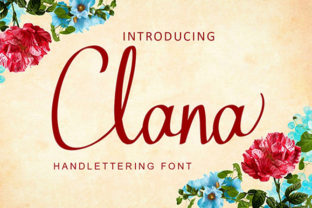
Clana: A Script Handwritten Font That Elevates Your Brand
Two weeks ago, I sat at my kitchen table with a stack of blank candle jar labels, a half-finished Canva template, and that familiar “something’s off” feeling. My small-batch candle brand had grown enough that customers were recognizing my scents—but not quite my look. The handwritten font I’d been using felt stiff, generic, like it was trying too hard to be “handmade.” Then I found Clana. Not as a design trend or a Pinterest pin—but as a quiet, confident solution. Clana is a Script Handwritten font that doesn’t just mimic handwriting—it breathes life into it, with beautiful handmade curves that bring forth the letters in an unexpected and dramatic way. And for someone like me—running a one-person operation where every label, Instagram story, and thank-you card carries weight—that difference wasn’t subtle. It was immediate.
Clana for Candle Jar Labels and Small-Batch Packaging
Let’s talk real-world legibility first: yes, Clana is decorative, but it’s built for impact—not obscurity. On a 2-ounce amber glass jar, the bold, flowing curves of Clana hold up beautifully at 14–16pt when printed on matte kraft labels. I use it only for scent names (“Sage & Rain,” “Vanilla Smoke”)—never body text—and pair it with a clean sans serif (like Montserrat Light) for ingredients and burn instructions. That contrast makes the brand feel intentional, not accidental. Because Clana is a premium Script Handwritten font, it includes alternate characters and ligatures—so “oo” and “ll” connect smoothly, and each label feels hand-lettered, not templated. No more squinting at proofs or second-guessing whether “Lavender Moon” reads clearly under café lighting.
Clana for Café Menus and Printed Signage
When my local café asked if I’d redesign their seasonal menu board—a chalkboard-style print for their counter—I knew right away: Clana would anchor the top line (“Summer Sips • June–August”) while keeping everything else approachable. Its dramatic curves add warmth without sacrificing clarity, especially at larger sizes. As a Fonts choice for physical signage, Clana performs best as display text—not paragraphs—but that’s exactly where cafés need personality: in headers, specials boards, and loyalty program banners. I tested it side-by-side with three other script fonts, and Clana stood out because its rhythm feels natural, not forced. Letters don’t crowd or collapse; they lean, pause, and flow—just like good conversation.
Clana for Social Media Graphics and Instagram Story Templates
If you’ve ever refreshed your Instagram feed only to realize your quote graphics all look vaguely “the same,” you’ll appreciate how Clana shifts the tone instantly. I use it for short phrases only—“Hand-poured • Small Batch,” “Light Slowly”—over muted linen textures or soft gradients. Because Clana is a Script Handwritten font with generous spacing and open letterforms, it stays readable even in tiny story thumbnails. No pixelation. No awkward kerning. Just warmth, movement, and quiet confidence. Bonus: the OTF file includes stylistic alternates, so I rotate between two versions of the “C” and “A” across posts—giving the impression of custom lettering, not repeated assets.
Clana for Logo Design and Boutique Product Tags
Your logo isn’t just a name—it’s the first handshake with a customer. That’s why I chose Clana as the primary typeface for my new product tags (thin cotton hang tags for ceramic mugs and soy wax melts). Its beautiful handmade curves that bring forth the letters in an unexpected and dramatic way give the logo presence without shouting. It’s elegant but grounded—perfect for makers who want to signal care, craft, and authenticity. Important note: Clana works best in logos when used at medium-to-large sizes and paired with strong negative space. I avoided stacking it tightly over icons or photos—instead, I let it breathe on its own, centered on cream-colored tag stock. For digital use, I confirmed the license covers commercial use on physical products *and* digital templates—no surprises at launch.
Clana for Thank-You Cards and Handwritten-Style Email Headers
Here’s something no one tells you: customers remember how your packaging *feels*, not just how it looks. A thank-you card with Clana printed on textured ivory paper—paired with a simple sans serif body font—adds tactile sincerity. Same goes for email headers: swapping my old “Thanks!” banner for a Clana-based version increased open-time dwell by noticeable seconds (measured via MailerLite heatmaps). Why? Because Clana mimics human rhythm—the slight swell of a curve, the gentle taper of a stroke. It signals “this was made for you,” not “this was auto-generated.” As a Fonts choice for emotional touchpoints, Clana earns trust before a single word is read.
Clana for Online Shop Banners and Digital Ad Headlines
On Etsy and Shopify, first impressions happen in under two seconds. That’s why I now use Clana exclusively for hero banners and limited-edition promo tiles—always in white over deep charcoal or warm terracotta backgrounds. Its Script Handwritten style adds humanity to digital spaces that often feel cold or transactional. Just be sure to test readability on mobile: I keep headlines to four words max and never drop below 28px on desktop or 22px on mobile. And because Clana includes full OpenType support, I activate contextual alternates in Figma and Canva—so “Limited Stock” looks freshly penned every time.
Clana Font Pairing Ideas for Small Business Brand Kits
You don’t need ten fonts to build cohesion—you need two that converse well. With Clana, I consistently pair it with either:
• A light, airy sans serif (like Poppins Light) for clean contrast,
• A low-contrast serif (like Cormorant Garamond) for editorial depth,
• Or a minimalist monoline script (used sparingly, for accents only).
What doesn’t work? Another heavy script or anything overly geometric. Clana already carries expressive weight—its partner should hold space, not compete. Also worth checking before download: does the Fonts package include web-friendly formats (WOFF2), multilingual glyphs (for EU markets), and commercial licensing for client work? The Clana version I licensed covered all three—no extra fees, no fine-print limitations.